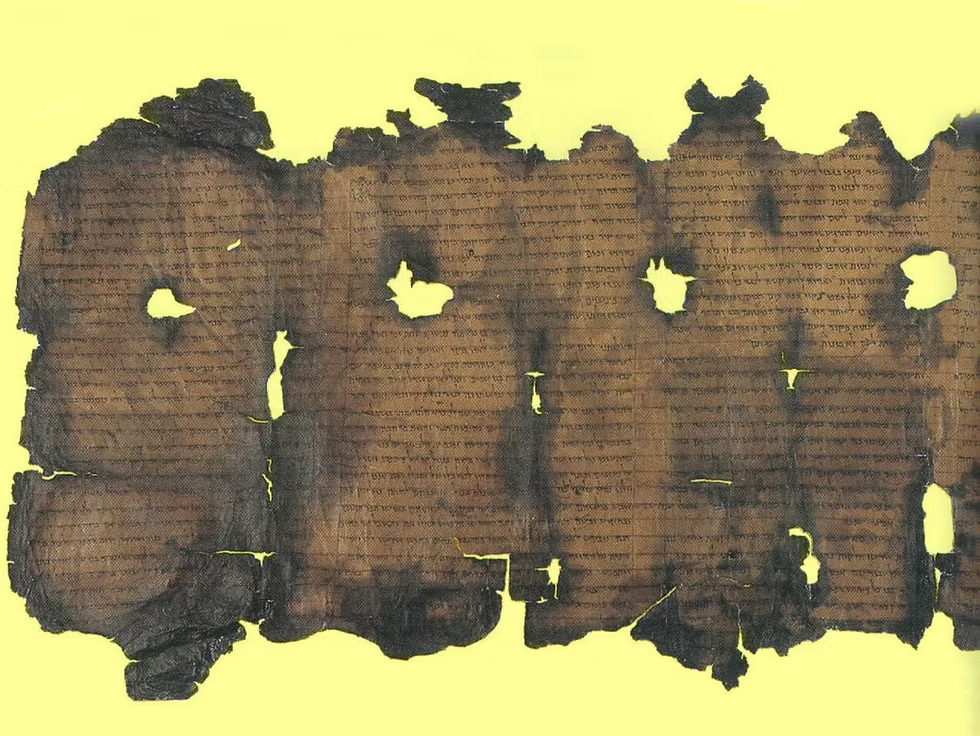
The Discoveries at Qumran and the Essenes
In 1947, Bedouin shepherds discovered a series of caves near Qumran in the Levant containing preserved manuscripts dating from roughly 250 BC to 70 AD. These manuscripts, now known as the Dead Sea Scrolls, were preserved primarily because of the extremely dry climate of the Judean Desert (rather than the high salt concentration of the Dead Sea itself). Before their discovery, the oldest substantial biblical manuscripts were ancient Greek manuscripts of the Septuagint which were translated beginning in the 3rd century BC.
Many of the scrolls appear to have belonged to a Jewish sect commonly identified with the Essenes. In the time of Jesus, the three best-known Jewish sects were the Pharisees, the Sadducees, and the Essenes. The Pharisees need no introduction. The Sadducees rejected the doctrine of the resurrection of the dead; Jesus debates them on this issue in Matthew 22:23–33. The Essenes had several practices that scholars consider broadly similar to those later associated with Christianity. They lived in tightly disciplined communities, awaited the coming of one (or more) Messianic figures, practiced frequent washings for purification (a precursor to baptism), and often withdrew from mainstream society into the wilderness.
Some Essenes also embraced an ascetic lifestyle in the desert. John the Baptist, who is described in the Gospels as eating locusts and wild honey and preached water baptism, may therefore have been an Essene. Biblical scholars have proposed that the man who provided the upper room for Jesus and his apostles at the Last Supper may have been associated with the Essenes.
In addition to copies of the Old Testament texts found in Qumran, there also existed many letters addressed within the community. More on this later.
The Foundation of Sola Fide
In 1515, Martin Luther began to form his doctrine of sola fide, or justification by faith alone. He believed this to be the plain reading of Paul, who wrote that we are not justified by works of the law, but faith. Paul writes:
“For we maintain that a person is justified by faith apart from the works of the law“. (Romans 3:28)
“Knowing that a man is not justified by the works of the law but by faith in Jesus Christ…”. (Galatians 2:16)
That’s all well and good. But, in a kill-shot for future would-be protestants, the Apostle James writes:
“You see then that a person is justified by works and not by faith alone.” (James 2:24)
Isn’t this a flat refutation of sola fide (which holds we are “justified by faith alone”)? And isn’t this a contradiction with Paul? Luther, shocked by the line, wrote:
“St. James’ epistle is really an epistle of straw, compared to these others, for it has nothing of the nature of the gospel about it”.
Rather than admit his idea of sola fide contradicted the bible, Luther argued that St. James’ epistle was a forgery. Luther tried to move James, along with a few other holy books, into the appendix of his version of the bible. Fortunately he was unsuccessful with changing the New Testament canon (he succeeded in changing the Old Testament canon). But wasn’t Luther correct in his frustration? Luther wrote:
“Many sweat to reconcile St. Paul and St. James, but in vain. ‘Faith justifies’ and ‘faith does not justify’ are a plain contradiction. Whoever can mix those two, and does not make them a contradiction, him I will give my doctor’s cap and allow him to call me a fool.”
As an aside, it’s generally a bad sign for your theology if it cannot reconcile the writings of two apostles. Fortunately for modern Christians, archeology has revealed how to reconcile St. Paul and St. James.
Taking Mr. Luther’s Doctor’s Cap
First, let’s see again what Paul writes. Paul writes that we are “justified by faith apart from works of the law”; we are “not justified by the works of the law”. Therefore, works do not justify. Right? But, no, that’s not what is written.
Paul does not disparage “works”. He comments on “works of the law”. What is a work of the law? No one really knew. We had no record of someone before the 2nd century using this term outside of Paul. Luther clearly interpreted works of the law to be equivalent with all works. For example, Luther would contend that a work of the law might be giving charity to the sick and elderly. Is that what Paul meant?
We return now to the Dead Sea Scrolls. It turns out that the only place the term “works of the law” is found outside of Paul’s letters is in an Essene letter found in the Dead Sea Scrolls dubbed 4QMMT. Written approximately 50 years before Paul wrote his letters, it allows us to see what “works of the law” are in this cultural context. Not only does it use the term, it gives examples of what “works of the law” are.
Here are some examples of “works of the law” defined in the time of Paul by the Essenes in 4QMMT:
- Purity of liquids: regulations stating that when a liquid is poured from a pure vessel into an impure one, the stream itself becomes a bridge that defiles the pure vessel.
- Prohibition of dogs: the banning of dogs from Jerusalem to prevent them from defiling the holy city by eating sacrificial remains.
- Temple exclusion: banning the blind and the deaf from entering the sanctuary, as well as the exclusion of Gentiles and their offerings from the Temple
- Agricultural Tithes: rules regarding the fruit of the fourth year and cattle tithes being given strictly to the priests.
These “works of the law” don’t sound like “good works”, “works of faith”, or “works of charity”. Ensuring that you do not pour water from a pure vessel into an unclean one is a different category compared to loving your enemy, protecting the weak, and giving charity to the poor. That’s because, evidently, “works of the law” are ceremonial works of the Jewish religion. Things that weren’t always in the Torah, but which became part of Jewish culture and ensured that Jews kept themselves separate from Gentiles.
Why was Paul talking about “works of the law”? One of Paul’s primary concerns was the Judaizer Heresy, which argued that Gentiles must get circumcised and adhere to the laws of the Jews if they wanted to follow Jesus. Paul fought fiercely against the Judaizers who held that we must continue “works of the law” as described by the Essenes. It’s fitting that this is a term used in an Essene letter because this is the group of 1st century Jews most likely to convert to Christianity (at least, from biblical evidence, because the Pharisees and Sadducees had both shown hostility towards Jesus).
Circumcision is another work of the law, which is why Paul speaks of it so much. Paul rebukes the Judaizers over and over in his epistles, stating that physical circumcision counts for nothing. Instead, as in Romans 2:29: “circumcision is circumcision of the heart, by the Spirit, not by the written code”. The Judaizers thought we were justified for rotely following rituals; Paul understood that we are justified according to what is formed in our hearts and then displayed outwardly. Paul’s primary message to Judaizers was summarized as such:
“There is neither Jew nor Gentile, neither slave nor free, nor is there male and female, for you are all one in Christ Jesus.” (Galatians 3:28)
There’s so much more to write on the topic of Paul vs. the Judaizers because this was one of Paul’s main focuses. Whereas Martin Luther thought Paul was speaking directly to him in the 1500s on the topic of justification, Paul was writing to obstinate Jewish Christian converts who thought Gentile Christians wouldn’t be saved unless they followed Jewish ritualistic practices.
Conclusion
Succinctly now for Luther’s understanding: as Paul argues, “works of the law” do not justify us; that is, acting according to Jewish ritualistic laws does not justify us. But, as James wrote, carrying out the works that Jesus commanded, like loving one another, does justify us (alongside faith).
Martin Luther did not have the archeological evidence which showed what “works of the law” meant. The argument could not be definitively settled in his time. Now, with new archeological evidence that informs us of Paul’s use of language, it’s clear that Luther was in error. Given that sola fide is the cornerstone of protestant theology, the entire reformation is built on a misunderstanding.